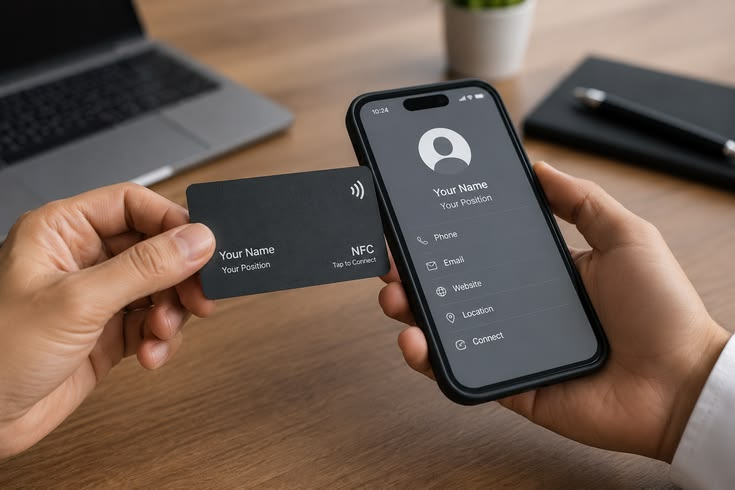
Sharing contact information during a meeting, sales visit, or networking event no longer has to depend only on handing someone a printed business card. NFC business cards can make digital information accessible by bringing the card close to a compatible phone, helping another person quickly reach the information or resources a business wants to share.
In this article, we explain what NFC business cards are, how the technology works, what type of information they can share, and when they can become a practical tool for salespeople, professionals, and business teams.
What Is an NFC Business Card?
An NFC business card is a card that contains Near Field Communication technology, commonly known as NFC.
This technology allows compatible devices to exchange information when they are placed very close to each other.
In an NFC business card, the chip can be used to direct a compatible phone to digital information related to a person or company.
Depending on the configuration, users may be able to access resources such as:
- Contact information.
- A company website.
- A professional profile.
- Social media profiles.
- Email information.
- A phone number.
- A contact form.
- A catalog or services page.
The goal is to make it easier to move from an in-person interaction to a digital point of contact.
How Does an NFC Business Card Work?
The experience for the user is relatively simple.
The card contains an NFC chip that can be detected by a compatible phone when the two are brought close together.
In general, the process works like this:
- A person brings the NFC card close to a compatible phone.
- The phone detects the information configured on the chip.
- The device displays a notification or available action.
- The user taps the notification.
- The associated content, such as a webpage or digital information, opens.
There is no need to manually type a web address or search online for the business name.
The exact experience can vary depending on the device, operating system, and how the card has been configured.
What Does NFC Mean?
NFC stands for Near Field Communication.
It is a short-range wireless technology designed to exchange information over a very small distance.
Many people already use NFC without necessarily knowing its name. The technology is also used for different proximity-based applications, including contactless payments, access systems, and connections between devices.
With a business card, however, NFC does not have to be used for payment. The technology can simply provide quick access to digital information.
What Information Can an NFC Business Card Share?
The content depends on how the card is prepared and the experience the business wants to create.
A card may direct the user to one specific resource or to a page that brings several contact options together.
Contact Information
It can provide access to information such as a person’s name, company, position, phone number, or email address.
Website
The card can direct someone to the company’s main website or to a specific page related to the professional’s services.
Social Media
It can make professional or corporate social profiles easier to access.
Portfolio
For designers, photographers, architects, salespeople, and other professionals, a card can lead to previous work or additional information about projects.
Product or Service Catalog
A sales representative may use the card to provide access to a catalog, menu, commercial presentation, or webpage describing an offer.
Contact Form
It can also direct users to a page where they can request a quote, schedule a consultation, or provide their contact information.
How Is an NFC Card Different From a Traditional Business Card?
A printed business card displays information directly on its surface. It usually contains a name, position, phone number, email address, logo, and website.
The recipient then needs to read that information and manually type, save, or visit it.
An NFC card adds a digital connection to that exchange.
Instead of limiting the information to what physically fits on the card, it can direct the user to digital content available online.
This does not mean that traditional business cards are no longer useful. The best option depends on the context, audience, and way a company handles professional contacts.
NFC Business Card vs. QR Code: What’s the Difference?
Both options can provide access to digital content, but the interaction is different.
With a QR code, users generally use their phone camera to scan the code.
With NFC, a compatible phone detects the card when it is placed sufficiently close.
In some situations, a company may use both options to provide different access methods depending on the device or user’s preference.
The technology itself is not the only important factor. The destination also needs to be clear, fast, and useful.
What Benefits Can NFC Business Cards Offer?
Easier Information Sharing
During a meeting or event, users can access information without manually typing a phone number, email address, or website.
Access to More Information
A physical card has limited space. A digital destination can provide access to several resources related to the business.
Connection Between In-Person and Digital Channels
A conversation can continue through a website, email, form, social media profile, or another communication channel.
A Modern Addition to a Professional Presentation
For businesses that already use technology throughout their sales processes, smart business cards can become another element in the way salespeople, representatives, and professionals present themselves.
Repeated Use
An NFC business card is designed to be used during multiple meetings and interactions rather than necessarily being handed over to every person you meet.
Who Can Use NFC Business Cards?
There is no single profession that can benefit from this type of card.
Its usefulness depends largely on how often a person exchanges business information face to face.
NFC cards may be practical for:
- Sales representatives.
- Entrepreneurs.
- Executives.
- Consultants.
- Real estate agents.
- Independent professionals.
- Sales teams.
- People who regularly attend networking events.
A company may also use them to create a more consistent way for different team members to present and share their professional information.
When Can an NFC Business Card Be Useful?
Sales Meetings
After presenting a proposal or speaking with a potential customer, the card can make it easier to exchange information immediately.
Trade Shows and Events
When many contacts are made in a short period of time, reducing the steps required to share information can make interactions more convenient.
Networking
During professional networking activities, the card can move an in-person conversation toward a digital profile or business resource.
Sales Visits
A representative can use the card to share contact information and direct a prospect toward a website, catalog, or information related to the company’s services.
Customer-Facing Locations
Depending on the business strategy, NFC can also provide a point of access to selected digital resources.
An NFC Card Does Not Replace a Sales Strategy
The technology can make information sharing easier, but it does not automatically turn a contact into a customer.
Results also depend on what happens after the interaction.
If someone arrives on an unclear webpage, finds outdated information, or cannot understand the next step, the convenience provided by NFC loses some of its value.
This is why businesses should consider the entire journey:
- What information will be shared.
- Where the user will be directed.
- What action the user should take.
- How the person can make contact again.
- Who will follow up afterward.
The card provides the connection. The experience that follows can help turn the contact into a business opportunity.
What Makes a Good NFC Business Card Experience?
Before introducing NFC cards to a sales team, businesses should define what the recipient will see after the interaction.
Clear Information
The user should immediately understand who the person or company is.
Mobile-Friendly Design
If the card directs users to a webpage, that page should work properly on mobile devices.
Easy-to-Find Actions
Calling, messaging, visiting the website, or requesting information should be simple.
Updated Information
Digital information associated with the experience should be kept current to avoid directing users to phone numbers, profiles, or pages that are no longer relevant.
Brand Consistency
The physical card and its digital destination should feel like parts of the same professional experience.
Can Every Phone Read an NFC Business Card?
To use the NFC interaction, a phone needs compatible NFC technology and the appropriate functionality to detect the card.
The experience may vary depending on the device model, operating system, and settings.
For this reason, businesses should test their NFC cards on different devices before incorporating them into a sales process and consider providing an alternative access method when necessary.
A visible QR code, for example, can provide a complementary option on a card designed to support both methods.
Do Users Need to Install an App?
This depends on how the card and digital experience are configured.
When NFC is simply used to direct a compatible phone to a web address, the interaction can use the NFC functionality available on the device.
When implementing a business solution, the experience should therefore be kept as simple as possible and users should be able to understand how to reach the information easily.
What Should You Define Before Creating NFC Cards for Your Business?
Before focusing only on the physical design, determine the role the card will play in your sales process.
Consider questions such as:
- Who will use the card?
- What type of customers will they meet?
- What information should be shared?
- Should users be directed to a specific webpage?
- What should the main call to action be?
- How will the business follow up after the interaction?
A card designed for a sales representative may require a different experience from one used by an executive, consultant, or professional who primarily attends networking events.
Make Professional Connections Easier to Continue
NFC business cards provide a practical way to connect an in-person interaction with the digital information of a professional or company. Their value is not simply in using a different technology, but in reducing the steps between a conversation and the next point of contact.
At Cuernosoft, we provide NFC smart business cards designed to make information sharing easier in professional and business environments.
Contact us to learn how NFC business cards can become part of your company’s professional presentation and communication.
